You Have Entered an Incorrect Username or Password 5 Times Please Try Again After 04 36 Seconds
Contents
Introduction
This document illustrates the use of the ping and traceroute commands. With the aid of some debug commands, this certificate captures a more detailed view of how these commands work.
Note:Enabling any debug commands on a production router may crusade serious issues. We recommend that you carefully read the Utilize the Debug Command section before you effect debug commands.
Prerequisites
Requirements
There are no specific requirements for this certificate.
Components Used
This document is not restricted to specific software and hardware versions.
The data in this document was created from the devices in a specific lab environment. All of the devices used in this document started with a cleared (default) configuration. If your network is live, make sure that you sympathise the potential impact of whatever command.
Conventions
For more information on document conventions, refer to the Cisco Technical Tips Conventions.
Background Information
In this document, nosotros utilize the bones configuration shown beneath every bit a footing for our examples:

The Ping Command
The ping command is a very mutual method for troubleshooting the accessibility of devices. Information technology uses a series of Internet Command Message Protocol (ICMP) Echo messages to determine:
-
Whether a remote host is agile or inactive.
-
The round-trip delay in communicating with the host.
-
Packet loss.
The ping command first sends an repeat asking packet to an address, and so waits for a answer. The ping is successful only if:
-
the repeat request gets to the destination, and
-
the destination is able to get an echo reply back to the source inside a predetermined fourth dimension called a timeout. The default value of this timeout is ii seconds on Cisco routers.
For all the options about this control, see "Ping" under Troubleshooting Commands.
The TTL value of a ping packet cannot be changed.
Here is an output example showing the ping command later on enabling the debug ip packet particular command:
 Warning:Using the debug ip packet particular command on a production router can crusade high CPU utilization. This may upshot in a severe operation deposition or a network outage. We recommend that you carefully read Apply the Debug Command earlier issuing debug commands.
Router1#debug ip packet particular IP package debugging is on (detailed) Router1#ping 12.0.0.2 Type escape sequence to arrest. Sending 5, 100-byte ICMP Echos to 12.0.0.2, timeout is 2 seconds: !!!!! Success rate is 100 percentage (5/five), circular-trip min/avg/max = 4/half dozen/8 ms Router1# Jan 20 15:54:47.487: IP: s=12.0.0.1 (local), d=12.0.0.ii (Serial0), len 100, sending Jan 20 15:54:47.491: ICMP type=8, code=0 !--- This is the ICMP packet 12.0.0.i sent to 12.0.0.2. !--- ICMP type=8 corresponds to the echo bulletin. Jan 20 15:54:47.523: IP: s=12.0.0.2 (Serial0), d=12.0.0.1 (Serial0), len 100, rcvd 3 Jan xx 15:54:47.527: ICMP blazon=0, code=0 !--- This is the reply we get from 12.0.0.2. !--- ICMP type=0 corresponds to the echo respond message. !--- Past default, the repeat count is five times, and so there will exist five !--- echo requests, and five echo replies.
The table below lists possible ICMP-blazon values.
| ICMP Type | Literal |
|---|---|
| 0 | echo-reply |
| iii | destination unreachable code 0 = net unreachable one = host unreachable 2 = protocol unreachable three = port unreachable 4 = fragmentation needed and DF set 5 = source road failed |
| 4 | source-quench |
| v | redirect code 0 = redirect datagrams for the network 1 = redirect datagrams for the host 2 = redirect datagrams for the type of service and network 3 = redirect datagrams for the type of service and host |
| vi | alternate-address |
| 8 | echo |
| ix | router-advertisement |
| x | router-solicitation |
| 11 | time-exceeded lawmaking 0 = time to alive exceeded in transit one = fragment reassembly time exceeded |
| 12 | parameter-problem |
| 13 | timestamp-request |
| 14 | timestamp-answer |
| xv | information-request |
| 16 | information-reply |
| 17 | mask-request |
| xviii | mask-reply |
| 31 | conversion-mistake |
| 32 | mobile-redirect |
The table below lists the possible output characters from the ping facility:
| Character | Clarification |
|---|---|
| ! | Each exclamation signal indicates receipt of a reply. |
| . | Each menstruum indicates the network server timed out while waiting for a answer. |
| U | A destination unreachable error PDU was received. |
| Q | Source quench (destination besides decorated). |
| G | Could not fragment. |
| ? | Unknown packet type. |
| & | Packet lifetime exceeded. |
Why Tin't I Ping?
If you are not able to successfully ping to an address, consider these causes:
Routing Upshot
Here are examples of unsuccessful ping attempts, determining the trouble, and what to practice to resolve the trouble.
This scenario is explained using the network topology diagram below:
Router1# ! ! interface Serial0 ip accost 12.0.0.1 255.255.255.0 no fair-queue clockrate 64000 ! ! Router2# ! ! interface Serial0 ip accost 23.0.0.2 255.255.255.0 no fair-queue clockrate 64000 ! interface Serial1 ip accost 12.0.0.2 255.255.255.0 ! ! Router3# ! ! interface Serial0 ip accost 34.0.0.3 255.255.255.0 no off-white-queue ! interface Serial1 ip accost 23.0.0.3 255.255.255.0 ! ! Router4# ! ! interface Serial0 ip address 34.0.0.four 255.255.255.0 no off-white-queue clockrate 64000 ! !
Let united states try to ping Router4 from Router1:
Router1#ping 34.0.0.four Blazon escape sequence to abort. Sending 5, 100-byte ICMP Echos to 34.0.0.4, timeout is ii seconds: ..... Success charge per unit is 0 percent (0/5)
Allow u.s. have a closer look at what has happened:
Router1#debug ip package IP packet debugging is on
Alert:Using the debug ip parcel command on a production router tin can cause high cpu utilization. This may result in a astringent performance degradation or a network outage. We recommend that you carefully read Use the Debug Command before issuing debug commands.
Router1#ping 34.0.0.4 Type escape sequence to abort. Sending v, 100-byte ICMP Echos to 34.0.0.4, timeout is two seconds: Jan 20 xvi:00:25.603: IP: s=12.0.0.one (local), d=34.0.0.iv, len 100, unroutable. Jan 20 16:00:27.599: IP: s=12.0.0.1 (local), d=34.0.0.iv, len 100, unroutable. Jan 20 sixteen:00:29.599: IP: south=12.0.0.one (local), d=34.0.0.4, len 100, unroutable. Jan 20 sixteen:00:31.599: IP: southward=12.0.0.i (local), d=34.0.0.four, len 100, unroutable. Jan 20 16:00:33.599: IP: s=12.0.0.1 (local), d=34.0.0.4, len 100, unroutable. Success charge per unit is 0 percentage (0/v)
Since no routing protocols are running on Router1, it does not know where to send its packet and nosotros get an "unroutable" message.
Now let u.s. add a static route to Router1:
Router1#configure terminal Enter configuration commands, i per line. End with CNTL/Z. Router1(config)#ip route 0.0.0.0 0.0.0.0 Serial0
We now have:
Router1#debug ip packet detail IP packet debugging is on (detailed) Router1#ping 34.0.0.4 Type escape sequence to arrest. Sending 5, 100-byte ICMP Echos to 34.0.0.four, timeout is 2 seconds: U.U.U Success rate is 0 percent (0/5) Jan 20 16:05:xxx.659: IP: s=12.0.0.1 (local), d=34.0.0.four (Serial0), len 100, sending Jan 20 16:05:30.663: ICMP blazon=8, code=0 Jan twenty xvi:05:thirty.691: IP: s=12.0.0.two (Serial0), d=12.0.0.1 (Serial0), len 56, rcvd 3 Jan 20 16:05:xxx.695: ICMP type=three, code=ane Jan 20 16:05:xxx.699: IP: s=12.0.0.1 (local), d=34.0.0.4 (Serial0), len 100, sending Jan 20 16:05:thirty.703: ICMP type=8, code=0 Jan 20 xvi:05:32.699: IP: due south=12.0.0.ane (local), d=34.0.0.4 (Serial0), len 100, sending Jan 20 xvi:05:32.703: ICMP type=8, lawmaking=0 Jan 20 xvi:05:32.731: IP: southward=12.0.0.ii (Serial0), d=12.0.0.1 (Serial0), len 56, rcvd 3 Jan xx 16:05:32.735: ICMP type=3, lawmaking=1 Jan 20 xvi:05:32.739: IP: south=12.0.0.ane (local), d=34.0.0.4 (Serial0), len 100, sending Jan 20 16:05:32.743: ICMP type=8, code=0
Now let u.s. examine what is wrong on Router2:
Router2#debug ip package detail IP parcel debugging is on (detailed) Router2# Jan 20 16:10:41.907: IP: southward=12.0.0.1 (Serial1), d=34.0.0.four, len 100, unroutable Jan 20 16:10:41.911: ICMP blazon=viii, code=0 January 20 16:10:41.915: IP: s=12.0.0.2 (local), d=12.0.0.1 (Serial1), len 56, sending Jan 20 sixteen:10:41.919: ICMP blazon=3, lawmaking=ane January 20 16:10:41.947: IP: s=12.0.0.1 (Serial1), d=34.0.0.four, len 100, unroutable Jan 20 sixteen:10:41.951: ICMP type=8, code=0 Jan 20 16:ten:43.943: IP: s=12.0.0.1 (Serial1), d=34.0.0.4, len 100, unroutable Jan 20 sixteen:x:43.947: ICMP type=8, code=0 Jan 20 xvi:10:43.951: IP: s=12.0.0.2 (local), d=12.0.0.i (Serial1), len 56, sending Jan twenty xvi:10:43.955: ICMP type=iii, code=one Jan 20 16:10:43.983: IP: southward=12.0.0.one (Serial1), d=34.0.0.4, len 100, unroutable Jan 20 16:10:43.987: ICMP type=8, lawmaking=0 January xx sixteen:10:45.979: IP: south=12.0.0.one (Serial1), d=34.0.0.4, len 100, unroutable Jan 20 16:10:45.983: ICMP type=viii, code=0 Jan xx sixteen:x:45.987: IP: s=12.0.0.ii (local), d=12.0.0.1 (Serial1), len 56, sending Jan 20 16:ten:45.991: ICMP blazon=three, code=i
Router1 is correctly sending its packets to Router2, simply Router2 doesn't know how to admission address 34.0.0.4. Router2 sends dorsum an "unreachable ICMP" bulletin to Router1.
Now let's enable Routing Information Protocol (RIP) on Router2 and Router3:
Router2# router rip network 12.0.0.0 network 23.0.0.0 Router3# router rip network 23.0.0.0 network 34.0.0.0
Now we take:
Router1#debug ip packet IP packet debugging is on Router1#ping 34.0.0.4 Blazon escape sequence to abort. Sending five, 100-byte ICMP Echos to 34.0.0.4, timeout is 2 seconds: Jan 20 xvi:16:xiii.367: IP: s=12.0.0.1 (local), d=34.0.0.4 (Serial0), len 100, sending. January 20 16:16:15.363: IP: south=12.0.0.ane (local), d=34.0.0.iv (Serial0), len 100, sending. January xx 16:16:17.363: IP: s=12.0.0.one (local), d=34.0.0.iv (Serial0), len 100, sending. Jan 20 16:xvi:nineteen.363: IP: s=12.0.0.1 (local), d=34.0.0.4 (Serial0), len 100, sending. January twenty sixteen:16:21.363: IP: s=12.0.0.1 (local), d=34.0.0.four (Serial0), len 100, sending. Success charge per unit is 0 percentage (0/5)
This is slightly ameliorate. Router1 is sending packets to Router4, merely is not getting whatever answer from Router4.
Permit the states see what the problem could be on Router4:
Router4#debug ip packet IP parcel debugging is on Router4# Jan 20 sixteen:eighteen:45.903: IP: s=12.0.0.1 (Serial0), d=34.0.0.4 (Serial0), len 100, rcvd 3 Jan twenty sixteen:xviii:45.911: IP: south=34.0.0.4 (local), d=12.0.0.1, len 100, unroutable January xx 16:18:47.903: IP: due south=12.0.0.1 (Serial0), d=34.0.0.iv (Serial0), len 100, rcvd three January 20 16:xviii:47.907: IP: s=34.0.0.4 (local), d=12.0.0.1, len 100, unroutable Jan 20 16:18:49.903: IP: s=12.0.0.i (Serial0), d=34.0.0.4 (Serial0), len 100, rcvd 3 January 20 16:eighteen:49.907: IP: due south=34.0.0.4 (local), d=12.0.0.i, len 100, unroutable Jan 20 xvi:eighteen:51.903: IP: south=12.0.0.ane (Serial0), d=34.0.0.4 (Serial0), len 100, rcvd iii Jan twenty 16:18:51.907: IP: s=34.0.0.4 (local), d=12.0.0.1, len 100, unroutable Jan 20 sixteen:xviii:53.903: IP: s=12.0.0.1 (Serial0), d=34.0.0.four (Serial0), len 100, rcvd 3 Jan 20 16:eighteen:53.907: IP: s=34.0.0.4 (local), d=12.0.0.1, len 100, unroutable
Router4 receives the ICMP packets, and tries to reply to 12.0.0.one, only because it does not have a route to this network, it simply fails.
Permit usa add a static route to Router4:
Router4(config)#ip route 0.0.0.0 0.0.0.0 Serial0
Now it works perfectly, and both sides can access each other:
Router1#ping 34.0.0.4 Blazon escape sequence to abort. Sending 5, 100-byte ICMP Echos to 34.0.0.4, timeout is 2 seconds: !!!!! Success rate is 100 per centum (5/5), round-trip min/avg/max = 32/35/36 ms
Interface Down
This is a situation where the interface stops working. In the example below, we try to ping Router4 from Router1:
Router1#ping 34.0.0.4 Type escape sequence to abort. Sending 5, 100-byte ICMP Echos to 34.0.0.4, timeout is 2 seconds: U.U.U Success rate is 0 percent (0/five)
Since the routing is fine, we will practise the troubleshooting pace-by-step. Start, allow us effort to ping Router2:
Router1#ping 12.0.0.two Type escape sequence to abort. Sending 5, 100-byte ICMP Echos to 12.0.0.2, timeout is 2 seconds: !!!!! Success rate is 100 percent (5/5), circular-trip min/avg/max = iv/4/4 ms
From the above, we encounter that the problem lies between Router2 and Router3. One possibility is that the serial interface on Router3 has been close downwards:
Router3#show ip interface cursory Serial0 34.0.0.iii YES manual up up Serial1 23.0.0.3 Yes manual administratively down down
This is quite simple to fix:
Router3#configure terminal Enter configuration commands, one per line. End with CNTL/Z. Router3(config)#interface s1 Router3(config-if)#no shutdown Router3(config-if)# Jan xx 16:20:53.900: %LINK-iii-UPDOWN: Interface Serial1, changed state to up Jan 20 sixteen:xx:53.910: %LINEPROTO-five-UPDOWN: Line protocol on Interface Serial1, changed state to upward
Admission-listing Command
In this scenario, we want to let merely telnet traffic to enter Router4 through interface Serial0 .
Router4(config)# admission-list 100 allow tcp any any eq telnet Router4(config)#interface s0 Router4(config-if)#ip access-group 100 in Router1#configure terminal Enter configuration commands, one per line. Cease with CNTL/Z. Router1(config)#admission-list 100 permit ip host 12.0.0.1 host 34.0.0.4 Router1(config)#access-list 100 permit ip host 34.0.0.iv host 12.0.0.1 Router1(config)#end Router1#debug ip packet 100 IP packet debugging is on Router1#debug ip icmp ICMP package debugging is on
Refer to the Utilise the Debug Control section for using access lists with debug commands.
When we now attempt to ping Router4, we have the following:
Router1#ping 34.0.0.4 Type escape sequence to abort. Sending five, 100-byte ICMP Echos to 34.0.0.4, timeout is 2 seconds: U.U.U Success rate is 0 percent (0/5) Jan 20 16:34:49.207: IP: southward=12.0.0.1 (local), d=34.0.0.4 (Serial0), len 100, sending Jan 20 xvi:34:49.287: IP: s=34.0.0.4 (Serial0), d=12.0.0.1 (Serial0), len 56, rcvd 3 Jan 20 16:34:49.291: ICMP: dst (12.0.0.1) administratively prohibited unreachable rcv from 34.0.0.four Jan 20 16:34:49.295: IP: s=12.0.0.1 (local), d=34.0.0.iv (Serial0), len 100, sending Jan 20 xvi:34:51.295: IP: s=12.0.0.1 (local), d=34.0.0.iv (Serial0), len 100, sending Jan 20 xvi:34:51.367: IP: south=34.0.0.four (Serial0), d=12.0.0.1 (Serial0), len 56, rcvd 3 January 20 16:34:51.371: ICMP: dst (12.0.0.1) administratively prohibited unreachable rcv from 34.0.0.4 Jan 20 16:34:51.379: IP: s=12.0.0.one (local), d=34.0.0.4 (Serial0), len 100, sending
At the end of an access-list command, we always have an implicit "deny all". This means that the ICMP packets that are entering the Serial 0 interface on Router4 are denied, and Router 4 sends an ICMP "administratively prohibited unreachable" message to the source of the original parcel as shown in the debug message. The solution is to add the post-obit line in the access-listing command:
Router4(config)#access-list 100 permit icmp any whatsoever
Address Resolution Protocol (ARP) Consequence
Here is a scenario with an Ethernet connection:
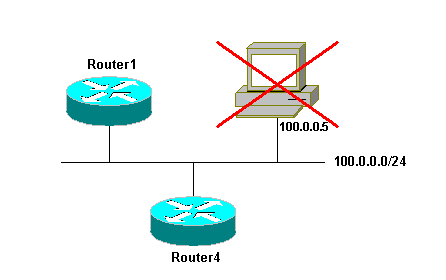
Router4#ping 100.0.0.five Blazon escape sequence to arrest. Sending 5, 100-byte ICMP Echos to 100.0.0.five, timeout is 2 seconds: January xx 17:04:05.167: IP: s=100.0.0.iv (local), d=100.0.0.5 (Ethernet0), len 100, sending Jan 20 17:04:05.171: IP: s=100.0.0.iv (local), d=100.0.0.5 (Ethernet0), len 100, encapsulation failed. Jan twenty 17:04:07.167: IP: s=100.0.0.4 (local), d=100.0.0.5 (Ethernet0), len 100, sending Jan 20 17:04:07.171: IP: s=100.0.0.4 (local), d=100.0.0.5 (Ethernet0), len 100, encapsulation failed. Jan 20 17:04:09.175: IP: south=100.0.0.iv (local), d=100.0.0.5 (Ethernet0), len 100, sending Jan 20 17:04:09.183: IP: due south=100.0.0.4 (local), d=100.0.0.v (Ethernet0), len 100, encapsulation failed. Jan 20 17:04:xi.175: IP: southward=100.0.0.iv (local), d=100.0.0.five (Ethernet0), len 100, sending Jan 20 17:04:xi.179: IP: s=100.0.0.4 (local), d=100.0.0.five (Ethernet0), len 100, encapsulation failed. Jan 20 17:04:13.175: IP: due south=100.0.0.4 (local), d=100.0.0.5 (Ethernet0), len 100, sending Jan twenty 17:04:xiii.179: IP: s=100.0.0.iv (local), d=100.0.0.5 (Ethernet0), len 100, encapsulation failed. Success rate is 0 percent (0/five) Router4#
In this case, the ping is not working due to "encapsulation failed". This ways that the router knows on which interface it has to ship the parcel, but does non know how to do it. In this case, yous need to understand how Address Resolution Protocol (ARP) works. See Configuring Address Resolution Methods for a detailed caption.
Basically, ARP is a protocol used to map the Layer 2 address (MAC accost) to a Layer 3 accost (IP address). You can check this mapping using the show arp control:
Router4#show arp Protocol Address Age (min) Hardware Addr Type Interface Cyberspace 100.0.0.4 - 0000.0c5d.7a0d ARPA Ethernet0 Net 100.0.0.one 10 0060.5cf4.a955 ARPA Ethernet0
Return to the "encapsulation failed" problem. Nosotros get a better idea of the problem using this debug command:
Router4#debug arp ARP packet debugging is on Router4#ping 100.0.0.5 Type escape sequence to abort. Sending 5, 100-byte ICMP Echos to 100.0.0.5, timeout is ii seconds: Jan 20 17:19:43.843: IP ARP: creating incomplete entry for IP address: 100.0.0.5 interface Ethernet0 Jan xx 17:xix:43.847: IP ARP: sent req src 100.0.0.iv 0000.0c5d.7a0d, dst 100.0.0.5 0000.0000.0000 Ethernet0. Jan 20 17:19:45.843: IP ARP: sent req src 100.0.0.4 0000.0c5d.7a0d, dst 100.0.0.5 0000.0000.0000 Ethernet0. Jan 20 17:19:47.843: IP ARP: sent req src 100.0.0.4 0000.0c5d.7a0d, dst 100.0.0.5 0000.0000.0000 Ethernet0. Jan 20 17:xix:49.843: IP ARP: sent req src 100.0.0.4 0000.0c5d.7a0d, dst 100.0.0.5 0000.0000.0000 Ethernet0. Jan 20 17:19:51.843: IP ARP: sent req src 100.0.0.iv 0000.0c5d.7a0d, dst 100.0.0.five 0000.0000.0000 Ethernet0. Success charge per unit is 0 percent (0/5)
The above output shows that Router4 is broadcasting packets by sending them to the Ethernet broadcast address FFFF.FFFF.FFFF. Here, the 0000.0000.0000 ways that Router4 is looking for the MAC address of the destination 100.0.0.5. Since it does not know the MAC address during the ARP asking in this example, it uses 0000.0000.000 as a placeholder in the broadcast frames sent out of interface Ethernet 0, asking which MAC accost corresponds to 100.0.0.5. If we do not get an answer, the respective address in the prove arp output is marked as incomplete:
Router4#show arp Protocol Address Age (min) Hardware Addr Type Interface Internet 100.0.0.iv - 0000.0c5d.7a0d ARPA Ethernet0 Internet 100.0.0.5 0 Incomplete ARPA Internet 100.0.0.1 ii 0060.5cf4.a955 ARPA Ethernet0
After a predetermined period, this incomplete entry is purged from the ARP table. As long every bit the corresponding MAC address is not in the ARP tabular array, the ping fails as a result of "encapsulation failed".
Delay
Past default, if you do not receive an answer from the remote end within two seconds, the ping fails:
Router1#ping 12.0.0.ii Type escape sequence to arrest. Sending v, 100-byte ICMP Echos to 12.0.0.two, timeout is ii seconds: ..... Success rate is 0 percent (0/5)
On networks with a slow link or a long filibuster, two seconds are not enough. You can modify this default using an extended ping:
Router1#ping Protocol [ip]: Target IP accost: 12.0.0.two Repeat count [five]: Datagram size [100]: Timeout in seconds [two]: 30 Extended commands [n]: Sweep range of sizes [n]: Blazon escape sequence to arrest. Sending 5, 100-byte ICMP Echos to 12.0.0.2, timeout is 30 seconds: !!!!! Success charge per unit is 100 pct (5/5), round-trip min/avg/max = 1458/2390/6066 ms
In the case above, increasing the timeout has led to a successful ping.
Annotation:The average round-trip time is more than than two seconds.
Correct Source Address
Here is an case of a typical state of affairs:

We add a LAN interface on Router1:
Router1(config)#interface e0 Router1(config-if)#ip address Router1(config-if)#ip address twenty.0.0.1 255.255.255.0
From a station on the LAN, you can ping Router1. From Router1 you tin ping Router2. But from a station on the LAN, you lot cannot ping Router2.
From Router1, you lot can ping Router2 because, past default, y'all use the IP address of the outgoing interface as the source address in your ICMP parcel. Router2 has not information about this new LAN. If it has to reply to a package coming from this network, information technology does not know how to handle information technology.
Router1#debug ip bundle IP bundle debugging is on
Warning: Using the debug ip bundle command on a production router can cause high cpu utilization. This may upshot in a severe performance degradation or a network outage. We recommend that you carefully read Use the Debug Command before issuing debug commands.
Router1#ping 12.0.0.2 Type escape sequence to arrest. Sending 5, 100-byte ICMP Echos to 12.0.0.ii, timeout is 2 seconds: !!!!! Success rate is 100 pct (five/5), round-trip min/avg/max = four/vii/ix ms Router1# January 20 16:35:54.227: IP: southward=12.0.0.1 (local), d=12.0.0.two (Serial0), len 100, sending Jan twenty sixteen:35:54.259: IP: s=12.0.0.2 (Serial0), d=12.0.0.1 (Serial0), len 100, rcvd iii
The output case above works because the source address of the packet we are sending is due south=12.0.0.1. If nosotros desire to simulate a packet coming from the LAN, nosotros take to utilize an extended ping:
Router1#ping Protocol [ip]: Target IP address: 12.0.0.2 Repeat count [5]: Datagram size [100]: Timeout in seconds [2]: Extended commands [northward]: y Source address or interface: xx.0.0.one Blazon of service [0]: Set DF bit in IP header? [no]: Validate reply data? [no]: Data design [0xABCD]: Loose, Strict, Record, Timestamp, Verbose[none]: Sweep range of sizes [n]: Blazon escape sequence to abort. Sending five, 100-byte ICMP Echos to 12.0.0.two, timeout is ii seconds: Jan twenty 16:forty:18.303: IP: s=twenty.0.0.1 (local), d=12.0.0.ii (Serial0), len 100, sending. Jan xx 16:forty:twenty.303: IP: s=twenty.0.0.1 (local), d=12.0.0.2 (Serial0), len 100, sending. January 20 16:40:22.303: IP: s=20.0.0.i (local), d=12.0.0.two (Serial0), len 100, sending. Jan 20 16:40:24.303: IP: south=20.0.0.1 (local), d=12.0.0.2 (Serial0), len 100, sending Jan 20 16:xl:26.303: IP: s=20.0.0.1 (local), d=12.0.0.two (Serial0), len 100, sending. Success rate is 0 pct (0/5)
This time, the source accost is 20.0.0.1, and it is not working! We are sending our packets, but we are not receiving anything. To set up this effect, we but have to add a route to 20.0.0.0 in Router2.
The basic dominion is that the pinged device should also know how to send the answer to the source of the ping.
High Input Queue Drops
When a parcel enters the router, the router attempts to forward it at interrupt level. If a match cannot be establish in an appropriate cache table, the packet is queued in the input queue of the incoming interface to exist processed. Some packets are e'er candy, merely with the appropriate configuration and in stable networks, the rate of processed packets must never congest the input queue. If the input queue is total, the packet is dropped.
Though the interface is upwards and yous may not ping the device due to high input queue drops. You can check the the input drops with the show interface command.
Router1#show interface Serial0/0/0 Serial0/0/0 is upward, line protocol is up MTU 1500 bytes, BW 1984 Kbit, DLY 20000 usec, reliability 255/255, txload 69/255, rxload 43/255 Encapsulation HDLC, loopback not prepare Keepalive fix (10 sec) Concluding input 00:00:02, output 00:00:00, output hang never Last clearing of "show interface" counters 01:28:49 Input queue: 76/75/5553/0 (size/max/drops/flushes); Total output drops: 1760 Queueing strategy: Class-based queueing Output queue: 29/1000/64/1760 (size/max total/threshold/drops) Conversations seven/129/256 (active/max active/max total) Reserved Conversations 4/4 (allocated/max allocated) Bachelor Bandwidth 1289 kilobits/sec !--- Output supressed As seen from the output, Input Queue Drop is loftier. Refer to Troubleshooting Input Queue Drops and Output Queue Drops in gild to troubleshoot Input/Output queue drops.
The Traceroute Command
The traceroute command is used to discover the routes that packets actually take when traveling to their destination. The device (for example, a router or a PC) sends out a sequence of User Datagram Protocol (UDP) datagrams to an invalid port address at the remote host.
Three datagrams are sent, each with a Time-To-Live (TTL) field value set to one. The TTL value of 1 causes the datagram to "timeout" as soon every bit information technology hits the first router in the path; this router then responds with an ICMP Fourth dimension Exceeded Bulletin (TEM) indicating that the datagram has expired.
Another three UDP letters are now sent, each with the TTL value set to two, which causes the second router to render ICMP TEMs. This process continues until the packets actually achieve the other destination. Since these datagrams are trying to access an invalid port at the destination host, ICMP Port Unreachable Messages are returned, indicating an unreachable port; this event signals the Traceroute plan that it is finished.
The purpose behind this is to tape the source of each ICMP Time Exceeded Message to provide a trace of the path the package took to reach the destination. For all the options about this command, see Trace (privileged).
Router1#traceroute 34.0.0.4 Type escape sequence to abort. Tracing the route to 34.0.0.4 1 12.0.0.2 4 msec four msec 4 msec 2 23.0.0.iii 20 msec xvi msec sixteen msec three 34.0.0.4 sixteen msec * 16 msec Jan xx 16:42:48.611: IP: southward=12.0.0.1 (local), d=34.0.0.4 (Serial0), len 28, sending January xx 16:42:48.615: UDP src=39911, dst=33434 January 20 16:42:48.635: IP: s=12.0.0.2 (Serial0), d=12.0.0.i (Serial0), len 56, rcvd 3 Jan 20 xvi:42:48.639: ICMP type=11, lawmaking=0 !--- ICMP Time Exceeded Message from Router2. Jan twenty sixteen:42:48.643: IP: s=12.0.0.1 (local), d=34.0.0.4 (Serial0), len 28, sending January 20 16:42:48.647: UDP src=34237, dst=33435 January 20 xvi:42:48.667: IP: s=12.0.0.ii (Serial0), d=12.0.0.ane (Serial0), len 56, rcvd three Jan 20 16:42:48.671: ICMP type=11, code=0 January twenty xvi:42:48.675: IP: due south=12.0.0.i (local), d=34.0.0.4 (Serial0), len 28, sending Jan xx xvi:42:48.679: UDP src=33420, dst=33436 January 20 xvi:42:48.699: IP: s=12.0.0.2 (Serial0), d=12.0.0.1 (Serial0), len 56, rcvd three Jan 20 16:42:48.703: ICMP blazon=11, code=0 This is the first sequence of packets we send with a TTL=1. The first router, in this case Router2 (12.0.0.2), drops the packet, and sends back to the source (12.0.0.1) a blazon=11 ICMP message. This corresponds to the Time Exceeded Message.
Jan 20 16:42:48.707: IP: s=12.0.0.i (local), d=34.0.0.4 (Serial0), len 28, sending Jan twenty 16:42:48.711: UDP src=35734, dst=33437 Jan 20 xvi:42:48.743: IP: southward=23.0.0.3 (Serial0), d=12.0.0.one (Serial0), len 56, rcvd 3 Jan 20 sixteen:42:48.747: ICMP type=11, lawmaking=0 !--- ICMP Time Exceeded Message from Router3. Jan xx 16:42:48.751: IP: south=12.0.0.one (local), d=34.0.0.4 (Serial0), len 28, sending Jan xx sixteen:42:48.755: UDP src=36753, dst=33438 Jan 20 16:42:48.787: IP: s=23.0.0.iii (Serial0), d=12.0.0.1 (Serial0), len 56, rcvd three Jan xx 16:42:48.791: ICMP type=11, lawmaking=0 Jan twenty 16:42:48.795: IP: s=12.0.0.i (local), d=34.0.0.four (Serial0), len 28, sending Jan twenty 16:42:48.799: UDP src=36561, dst=33439 Jan twenty 16:42:48.827: IP: s=23.0.0.3 (Serial0), d=12.0.0.one (Serial0), len 56, rcvd 3 Jan 20 16:42:48.831: ICMP type=xi, code=0 The aforementioned procedure occurs for Router3 (23.0.0.3) with a TTL=2:
Jan xx 16:42:48.839: IP: s=12.0.0.ane (local), d=34.0.0.4 (Serial0), len 28, sending Jan twenty 16:42:48.843: UDP src=34327, dst=33440 Jan 20 16:42:48.887: IP: s=34.0.0.4 (Serial0), d=12.0.0.1 (Serial0), len 56, rcvd 3 Jan 20 sixteen:42:48.891: ICMP type=three, code=iii !--- Port Unreachable message from Router4. Jan 20 xvi:42:48.895: IP: s=12.0.0.1 (local), d=34.0.0.iv (Serial0), len 28, sending Jan 20 16:42:48.899: UDP src=37534, dst=33441 January 20 sixteen:42:51.895: IP: s=12.0.0.1 (local), d=34.0.0.4 (Serial0), len 28, sending January 20 xvi:42:51.899: UDP src=37181, dst=33442 Jan 20 xvi:42:51.943: IP: s=34.0.0.4 (Serial0), d=12.0.0.i (Serial0), len 56, rcvd 3 Jan twenty 16:42:51.947: ICMP type=3, code=3 With a TTL=iii, we finally reach Router4. This fourth dimension, since the port is non valid, Router4 sends back to Router1 an ICMP message with type=3, a Destination Unreachable Message, and code=3 meaning port unreachable.
The tabular array below lists the characters that can announced in the traceroute command output.
IP Traceroute Text Characters
| Grapheme | Description |
|---|---|
| nn msec | For each node, the circular-trip fourth dimension in milliseconds for the specified number of probes |
| * | The probe timed out |
| A | Administratively prohibited (instance, access-list) |
| Q | Source quench (destination too busy) |
| I | User interrupted test |
| U | Port unreachable |
| H | Host unreachable |
| Northward | Network unreachable |
| P | Protocol Unreachable |
| T | Timeout |
| ? | Unknown packet type |
Operation
Using the ping and traceroute commands, we obtain the circular-trip fourth dimension (RTT). This is the time required to send an echo packet, and go an answer dorsum. This tin can be useful to have a rough idea of the delay on the link. However, these figures are not precise plenty to be used for functioning evaluation.
When a packet destination is the router itself, this parcel has to be procedure-switched. The processor has to handle the information from this packet, and ship an answer back. This is non the main goal of a router. By definition, a router is built to route packets. Answering a ping is offered as a all-time-effort service.
To illustrate this, here is an instance of a ping from Router1 to Router2:
Router1#ping 12.0.0.2 Blazon escape sequence to arrest. Sending 5, 100-byte ICMP Echos to 12.0.0.ii, timeout is 2 seconds: !!!!! Success rate is 100 pct (v/5), round-trip min/avg/max = 4/four/4 ms
The RTT is approximately four milliseconds. After you enable some procedure-intensive features on Router2, try to ping Router2 from Router1.
Router1#ping 12.0.0.ii Blazon escape sequence to abort. Sending v, 100-byte ICMP Echos to 12.0.0.two, timeout is ii seconds: !!!!! Success charge per unit is 100 percent (5/5), circular-trip min/avg/max = 24/25/28 ms
The RTT has dramatically increased hither. Router2 is quite busy, and answering the ping is not its principal priority.
A better mode to examination router performance is with traffic going through the router:
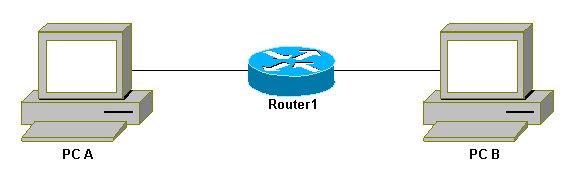
The traffic is then fast-switched, and is handled by the router with the highest priority. To illustrate this, let us go back to our basic network:
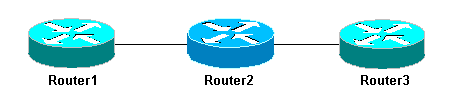
Allow us ping Router3 from Router1:
Router1#ping 23.0.0.iii Type escape sequence to abort. Sending 5, 100-byte ICMP Echos to 23.0.0.three, timeout is 2 seconds: !!!!! Success rate is 100 percent (5/5), round-trip min/avg/max = 32/32/32 ms
The traffic is going through Router2, and is now fast-switched.
Now let us enable the process-intensive feature on Router2:
Router1#ping 23.0.0.iii Type escape sequence to abort. Sending 5, 100-byte ICMP Echos to 23.0.0.3, timeout is ii seconds: !!!!! Success rate is 100 per centum (v/5), round-trip min/avg/max = 32/32/36 ms
There is almost no divergence. This is considering, on Router2, the packets are now handled at interrupt level.
Use the Debug Command
Before issuing debug commands, delight see Of import Information on Debug Commands.
The different debug commands we take used so far gives us an insight into what happens when nosotros use a ping or traceroute command. They can besides be useful for troubleshooting. However, in a production environment, debugs should be used with circumspection. If your CPU is not powerful, or if you lot have a lot of procedure-switched packets, they tin can easily stall your device. There are a couple of ways to minimize the touch of the debug command on the router. One mode is to use admission lists to narrow down the specific traffic that you want to monitor. Here is an case:
Router4#debug ip packet ? <ane-199> Access list <1300-2699> Access list (expanded range) detail Impress more debugging detail Router4#configure final Router4(config)#access-list 150 permit ip host 12.0.0.1 host 34.0.0.4 Router4(config)#^Z Router4#debug ip packet 150 IP bundle debugging is on for admission list 150 Router4#show debug Generic IP: IP packet debugging is on for admission list 150 Router4#show admission-list Extended IP access list 150 let ip host 12.0.0.1 host 34.0.0.4 (5 matches)
With this configuration, Router4 only prints the debug bulletin that matches the admission-list 150. A ping coming from Router1 causes the post-obit message to be displayed:
Router4# Jan xx 16:51:16.911: IP: due south=12.0.0.1 (Serial0), d=34.0.0.4 (Serial0), len 100, rcvd 3 January 20 16:51:17.003: IP: s=12.0.0.1 (Serial0), d=34.0.0.iv (Serial0), len 100, rcvd three Jan xx 16:51:17.095: IP: s=12.0.0.ane (Serial0), d=34.0.0.iv (Serial0), len 100, rcvd 3 Jan 20 16:51:17.187: IP: southward=12.0.0.ane (Serial0), d=34.0.0.4 (Serial0), len 100, rcvd iii Jan twenty 16:51:17.279: IP: s=12.0.0.1 (Serial0), d=34.0.0.iv (Serial0), len 100, rcvd 3
Nosotros no longer see the answer from Router4 considering, these packets practise not friction match the access-listing. To see them, we should add the following:
Router4(config)#access-listing 150 permit ip host 12.0.0.1 host 34.0.0.four Router4(config)#admission-list 150 allow ip host 34.0.0.4 host 12.0.0.1
We then have:
Jan 20 16:53:16.527: IP: southward=12.0.0.ane (Serial0), d=34.0.0.4 (Serial0), len 100, rcvd iii Jan 20 16:53:xvi.531: IP: due south=34.0.0.4 (local), d=12.0.0.1 (Serial0), len 100, sending January 20 sixteen:53:16.627: IP: s=12.0.0.1 (Serial0), d=34.0.0.iv (Serial0), len 100, rcvd 3 Jan 20 sixteen:53:16.635: IP: s=34.0.0.iv (local), d=12.0.0.i (Serial0), len 100, sending Jan 20 16:53:16.727: IP: s=12.0.0.1 (Serial0), d=34.0.0.four (Serial0), len 100, rcvd 3 Jan twenty 16:53:16.731: IP: southward=34.0.0.4 (local), d=12.0.0.one (Serial0), len 100, sending Jan twenty 16:53:16.823: IP: southward=12.0.0.ane (Serial0), d=34.0.0.iv (Serial0), len 100, rcvd iii Jan 20 16:53:sixteen.827: IP: s=34.0.0.four (local), d=12.0.0.i (Serial0), len 100, sending Jan 20 16:53:16.919: IP: south=12.0.0.one (Serial0), d=34.0.0.4 (Serial0), len 100, rcvd 3 Jan xx 16:53:16.923: IP: southward=34.0.0.four (local), d=12.0.0.i (Serial0), len 100, sending
Some other way of minimizing the impact of the debug control is to buffer the debug messages and show them using the evidence log control one time the debug has been turned off:
Router4#configure terminal Router4(config)#no logging console Router4(config)#logging buffered 5000 Router4(config)#^Z Router4#debug ip parcel IP packet debugging is on Router4#ping 12.0.0.one Type escape sequence to abort. Sending 5, 100-byte ICMP Echos to 12.0.0.one, timeout is two seconds: !!!!! Success rate is 100 percent (5/five), circular-trip min/avg/max = 36/36/37 ms Router4#undebug all All possible debugging has been turned off Router4#bear witness log Syslog logging: enabled (0 messages dropped, 0 flushes, 0 overruns) Console logging: disabled Monitor logging: level debugging, 0 messages logged Buffer logging: level debugging, 61 letters logged Trap logging: level advisory, 59 message lines logged Log Buffer (5000 bytes): Jan xx 16:55:46.587: IP: s=34.0.0.4 (local), d=12.0.0.one (Serial0), len 100, sending Jan 20 16:55:46.679: IP: due south=12.0.0.1 (Serial0), d=34.0.0.4 (Serial0), len 100, rcvd 3
As you can run into, the ping and traceroute commands are very helpful utilities that you can use to troubleshoot network access issues. They are also very piece of cake to utilise. Every bit these ii commands are the most widely used commands past network engineers, agreement them is very crucial for troubleshooting network connectivity.
Related Information
- Using the Extended ping and Extended traceroute Commands
- Technical Support - Cisco Systems
Source: https://www.cisco.com/c/en/us/support/docs/ios-nx-os-software/ios-software-releases-121-mainline/12778-ping-traceroute.html
0 Response to "You Have Entered an Incorrect Username or Password 5 Times Please Try Again After 04 36 Seconds"
Enviar um comentário