Ritual That Jews Go Through to Become Holy Again
| Yom Kippur | |
|---|---|
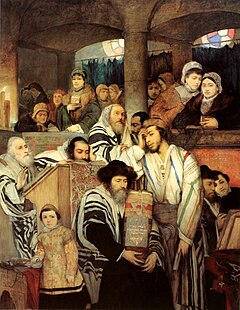 Jews Praying in the Synagogue on Yom Kippur, by Maurycy Gottlieb (1878) | |
| Official proper noun | יוֹם כִּיפּוּר |
| Observed past |
|
| Type | Jewish |
| Significance | Atonement for personal sins, fate of each person is sealed for the upcoming twelvemonth |
| Observances |
|
| Date | 10th day of Tishrei |
| 2021 date | Sunset, xv September – nightfall, 16 September |
| 2022 engagement | Sunset, 4 October – nightfall, 5 Oct |
| 2023 appointment | Dusk, 24 September – nightfall, 25 September |
| 2024 date | Sunset, eleven October – nightfall, 12 October |
| Frequency | Almanac |
| Related to | Rosh Hashanah, which precedes Yom Kippur |
Yom Kippur (;[i] Hebrew: יוֹם כִּיפּוּר, romanized: Yōm Kīpūr , IPA: [ˈjom kiˈpuʁ], lit. 'Day of Amende'; plural יום הכיפורים , Yom HaKipurim ) is the holiest day of the twelvemonth in Judaism. Its central themes are amende and repentance. Jews traditionally observe this holy day with a day-long fast, confession, and intensive prayer, often spending most of the twenty-four hour period in synagogue services. The High Holy Days comprise both Rosh HaShanah and Yom Kippur.
Etymology [edit]
Yom ( יוֹם ) means "day" in Hebrew and Kippur ( כִּפּוּר ) is translated to "atonement".[two] The mutual English translation of Yom Kippur is Solar day of Atonement, all the same, this translation lacks precision. The proper name Yom Kippur is based on the Torah verse, "...only on the 10th solar day of the seventh month it is the day of kippurim unto you lot..."[three] The literal translation of kippurim is cleansing. Yom Kippur is a Jewish twenty-four hours to atone for misdeeds and become apple-pie and purified from them.[iv]
Rosh Hashanah and Yom Kippur [edit]
Yom Kippur is "the 10th day of [the] seventh month"[5] (Tishrei) and is as well known as the "Sabbath of Sabbaths".[half dozen] Rosh Hashanah (referred to in the Torah as Yom Teruah) is the first mean solar day of that month co-ordinate to the Hebrew calendar. Yom Kippur completes the annual catamenia known in Judaism equally the High Holy Days or Yamim Nora'im ("Days of Awe") that commences with Rosh Hashanah.[6] The ten days from Rosh Hashanah to Yom Kippur represent to the last 10 days of the 40-solar day period Moses was on Mount Sinai receiving the 2d set of tablets.[vii]
Heavenly books opened [edit]
According to Jewish tradition, God inscribes each person's fate for the coming year into a volume, the Book of Life, on Rosh Hashanah, and waits until Yom Kippur to "seal" the verdict.[viii] During the Days of Awe, a Jew tries to amend their behavior and seek forgiveness for wrongs done against God (bein adam leMakom) and confronting other human beings (bein adam lechavero). The evening and day of Yom Kippur are fix aside for public and individual petitions and confessions of guilt (Vidui). At the terminate of Yom Kippur, ane hopes that they take been forgiven past God.[ix]
Prayer service [edit]
The Yom Kippur prayer service includes several unique aspects. One is the actual number of prayer services. Different a regular day, which has iii prayer services (Ma'ariv, the evening prayer; Shacharit, the morning prayer; and Mincha, the afternoon prayer), or a Shabbat or Yom Tov, which have 4 prayer services (a'arivt; Shacharit; Mussaf, the additional prayer; and Mincha), Yom Kippur has five prayer services (Ma'ariv; Shacharit; Mussaf; Mincha; and Ne'ilah, the endmost prayer).[10] The prayer services also include private and public confessions of sins (Vidui)[viii] and a unique prayer dedicated to the special Yom Kippur avodah (service) of the Kohen Gadol (high priest) in the Holy Temple in Jerusalem.[xi]
Observance [edit]
Equally one of the most culturally significant Jewish holidays, Yom Kippur is observed by many secular Jews who may not observe other holidays. Many secular Jews attend synagogue on Yom Kippur—for many secular Jews the High Holy Days are the only times of the year during which they attend synagogue[12]—causing synagogue attendance to soar.
Preceding day [edit]

Erev Yom Kippur (lit. "eve [of] day [of] atonement") is the day preceding Yom Kippur, respective to the 9th 24-hour interval of the Hebrew month of Tishrei. This 24-hour interval is commemorated with additional morning prayers, asking others for forgiveness, giving charity, performing the kapparot ritual, an extended afternoon prayer service, and 2 festive meals.[13]
General observances [edit]
Leviticus 16:29 mandates establishment of this holy 24-hour interval on the tenth day of the seventh month as the 24-hour interval of amende for sins.[xiv] It calls it the Sabbath of Sabbaths and a mean solar day upon which 1 must afflict one'south soul.
Leviticus 23:27 decrees that Yom Kippur is a strict day of residual.[15]
Five additional prohibitions are traditionally observed, as detailed in the Jewish oral tradition.[16]
The number five is a prepare number, relating to:
- In the Yom Kippur department of the Torah, the discussion soul appears five times.
- The soul is known by 5 dissever names: soul, wind, spirit, living 1 and unique one.
- Unlike regular days, which have 3 prayer services, Yom Kippur has v – Maariv, Shacharit, Mussaf, Minchah and Neilah.
- The Kohen Gadol rinsed himself in the mikveh (ritual bath) five times on Yom Kippur.[17]
The prohibitions are the following:
- No eating and drinking
- No wearing of leather shoes
- No bathing or washing
- No anointing oneself with perfumes or lotions
- No marital relations
A parallel has been drawn between these activities and the human condition according to the Biblical business relationship of the expulsion from the garden of Eden.[18] Refraining from these symbolically represents a render to a pristine state of re-attachment to the purity of Edenic existence, and symbolically therefore one avoids that which arose as a need only after the exile from Eden: The Eden account tells of God saying "thorns and thistles will grow in your manner...the serpent will raise its caput (to bite you) and you will requite your heel (to crush it)" and so in the new post-Edenic existence information technology became necessary to wear strong protective shoes, so these are avoided on Yom Kippur (run across commodity for specifics). The Eden account also states that equally opposed to the automatic food and drink in Eden, it volition be necessary to piece of work for it "past the sweat of your forehead", and so food and beverage are refrained from on Yom Kippur, every bit well every bit washing, and the use of cosmetics to remove sweat or its aroma etc. Similarly for the description of the postal service-Edenic relationship between man and woman, then on Yom Kippur marital relations are avoided.[eighteen]
Total abstention from nutrient and drinkable too equally keeping the other traditions begins at sundown, and ends after nightfall the following mean solar day. One should add together a few minutes to the showtime and end of the 24-hour interval, called tosefet Yom Kippur, lit. "improver to Yom Kippur". Although the fast is required of all good for you men over 13 or women over 12, it is waived in the example of sure medical conditions.[ commendation needed ]
Past refraining from these activities, the torso is uncomfortable but can still survive. The soul is considered to exist the life forcefulness in a body. Therefore, by making ane's body uncomfortable, one's soul is uncomfortable. By feeling pain one tin can feel how others feel when they are in pain.[19] This is the purpose of the prohibitions.
Virtually all Jewish holidays involve meals, but since Yom Kippur involves fasting, Jewish law requires i to eat a big and festive repast on the afternoon before Yom Kippur, later the Mincha (afternoon) prayer. This meal is meant to make upwards for the disability to eat a big meal on the solar day of Yom Kippur instead, due to the prohibition from eating or drinking.[ citation needed ]
Wearing white clothing (or a kittel for Ashkenazi Jews), is traditional to symbolize ane's purity on this mean solar day. Many Orthodox men immerse themselves in a mikveh on the day before Yom Kippur.[xx]
In order to gain atonement from God, i must:[17]
- Pray
- Repent of one'southward sins
- Give to charity
Eve [edit]
Earlier sunset on Yom Kippur eve, worshipers gather in the synagogue. The Ark is opened and two people accept from it two Sifrei Torah (Torah scrolls). So they take their places, one on each side of the Hazzan, and the three recite (in Hebrew):
In the tribunal of Sky and the tribunal of world, we hold it lawful to pray with transgressors.
The cantor so chants the Kol Nidre prayer (Aramaic: כל נדרי, English translation: "All vows"). It is recited in Aramaic. Its name "Kol Nidre" is taken from the opening words, and translates "All vows":
All personal vows nosotros are likely to make, all personal oaths and pledges we are likely to have between this Yom Kippur and the adjacent Yom Kippur, we publicly renounce. Let them all be relinquished and abased, null and void, neither business firm nor established. Let our personal vows, pledges and oaths be considered neither vows nor pledges nor oaths.[21]
The leader and the congregation then say together three times "May all the people of Israel be forgiven, including all the strangers who live in their midst, for all the people are in fault." The Torah scrolls are then placed back into the Ark, and the Yom Kippur evening service begins.[ commendation needed ]
Prayer services [edit]
Many married Ashkenazi Orthodox men wear a kittel, a white robe-like garment for evening prayers on Yom Kippur, otherwise used past men on their wedding day.[22] [23] They likewise wear a tallit (prayer shawl), which is typically worn just during morning services.[24]
Prayer services begin with the Kol Nidre prayer, which is recited before sunset. Kol Nidre is a prayer that dates back to ninth century Israel. It is recited in a dramatic style, before the open ark, using a tune that dates back to the 16th century.[25] So the service continues with the evening prayers (Ma'ariv or Arvit) and an extended Selichot service.[ commendation needed ]
The morning prayer service is preceded past litanies and petitions of forgiveness called selichot; on Yom Kippur, many selichot are woven into the liturgy of the mahzor (prayer book). The morning prayers are followed by an added prayer (Mussaf) as on all other holidays. This is followed by Mincha (the afternoon prayer) which includes a reading (Haftarah) of the entire Book of Jonah, which has every bit its theme the story of God'south willingness to forgive those who repent.[ citation needed ]
The service concludes with the Ne'ila ("closing") prayer, which begins shortly earlier sunset, when the "gates of prayer" will exist closed. Yom Kippur comes to an end with a recitation of Shema Yisrael and the bravado of the shofar,[26] which marks the decision of the fast.[24]
Reform Judaism [edit]
Reform synagogues more often than not experience their largest attendance of the year on Yom Kippur and Rosh Hashanah for worship services. The prayer philosophy of Reform, as described in the introduction of the movement'southward High Holy Day prayerbook, "Mishkan Hanefesh", is to reflect "varied theological approaches that enable a diverse congregation to share religious experience... with a commitment to Reform tradition, too as [to] the larger Jewish tradition." A central feature of these Reform services is the rabbinic sermon. "For more than a century and a half in the Reform Motility," writes Rabbi Lance Sussman, "High Holiday sermons were among the nearly predictable events in synagogue life, especially on the eve of Rosh Hashanah and Kol Nidre night."[27]
Repentance (Teshuva) and confessional (Vidui) [edit]
The Talmud states, "Yom Kippur atones for those who repent and does not atone for those who do non apologize".[28] Repentance in Judaism is washed through a process called Teshuva, which in its most basic form consists of regretting having committed the sin, resolving non to commit that sin in the futurity and to confess that sin before God. Confession in Judaism is called Vidui (Hebrew וידוי). In that location is also a commandment to repent on Yom Kippur.[29] Accordingly, Yom Kippur is unique for the confessional, or Vidui, that is part of the prayer services. In keeping with the requirement to repent on Yom Kippur, Jews recite the full Vidui a total of nine times: once during Mincha on Yom Kippur eve, and on Yom Kippur itself during Ma'ariv (two times), Shacharit (2 times), Musaf (2 times), and Mincha (two times); at Ne'eilah, only the short confessional is said. The outset time in each service takes identify during the personal recitation of the Amidah (standing, silent prayer), and the 2nd fourth dimension during the cantor'south repetition of the Amidah (except during the preceding Mincha), in a public recitation.[ citation needed ]
The Yom Kippur confessional consists of two parts: a brusque confession first with the discussion Ashamnu (אשמנו, "we have sinned"), which is a serial of words describing sin arranged co-ordinate to the aleph-bet (Hebrew alphabetic guild), and a long confession, beginning with the words Al Cheyt (על חטא, "for the sin"), which is a fix of 22 double acrostics, also bundled according to the aleph-bet, enumerating a range of sins.[ commendation needed ]
Avodah: remembering the Temple service [edit]
A recitation of the sacrificial service of the Temple in Jerusalem traditionally features prominently in both the liturgy and the religious thought of the vacation.[eleven] Specifically, the Avodah ("service") in the Musaf prayer recounts in great detail the sacrificial ceremonies of the Yom Kippur Korbanot (sacrificial offerings) that are recited in the prayers but have not been performed for 2,000 years, since the destruction of the Second Temple in Jerusalem by the Romans.
This traditional prominence is rooted in the Babylonian Talmud's description of how to attain amende post-obit the devastation of the Temple. Co-ordinate to Talmud tractate Yoma, in the absence of a Temple, Jews are obligated to written report the Loftier Priest's ritual on Yom Kippur, and this report helps accomplish atonement for those who are unable to benefit from its actual performance. In Orthodox Judaism, appropriately, studying the Temple ritual on Yom Kippur represents a positive rabbinically ordained obligation which Jews seeking atonement are required to fulfill.
In Orthodox synagogues and many Conservative ones a detailed description of the Temple ritual is recited on the twenty-four hour period. In well-nigh Orthodox and some Conservative synagogues, the entire congregation prostrates themselves at each betoken in the recitation where the Kohen Gadol (Loftier Priest) would pronounce the Tetragrammaton (God'south holiest name, co-ordinate to Judaism).
The main section of the Avodah is a threefold recitation of the High Priest'south deportment regarding expiation in the Holy of Holies. Performing the sacrificial acts and reciting Leviticus 16:xxx, ("Your upright children"[thirty]). (These 3 times, plus in some congregations the Aleinu prayer during the Musaf Amidah on Yom Kippur and Rosh Hashanah, are the only times in Jewish services when Jews engage in prostration, with the exception of some Yemenite Jews and talmedhei haRambam (disciples of Maimonides) who may prostrate themselves on other occasions during the year. A variety of liturgical poems are added, including a poem recounting the radiance of the countenance of the Kohen Gadol after exiting the Holy of Holies, traditionally believed to emit palpable calorie-free in a mode echoing the Torah'due south account of the eyebrow of Moses subsequently descending from Mount Sinai, besides every bit prayers for the speedy rebuilding of the Temple and the restoration of sacrificial worship. There are a diverseness of other customs, such as hand gestures to mime the sprinkling of blood (one sprinkling upwards and seven downwards per ready of eight).[31]
Orthodox liturgies include prayers lamenting the inability to perform the Temple service and petitioning for its restoration, which Conservative synagogues generally omit. In some Conservative synagogues, only the Hazzan (cantor) engages in full prostration. Some Conservative synagogues abridge the recitation of the Avodah service to varying degrees, and some omit it entirely. Reconstructionist services omit the unabridged service every bit inconsistent with modernistic sensibilities.
Appointment of Yom Kippur [edit]
Yom Kippur falls each year on the 10th day of the Jewish month of Tishrei, which is nine days after the first twenty-four hours of Rosh Hashanah. In terms of the Gregorian calendar, the earliest appointment on which Yom Kippur can fall is September fourteen, as happened most recently in 1899 and 2013. The latest Yom Kippur can occur relative to the Gregorian dates is on October xiv, as happened in 1967 and will happen again in 2043. After 2089, the differences between the Hebrew agenda and the Gregorian calendar volition result in Yom Kippur falling no before than September 15.[32] Gregorian calendar dates for contempo and upcoming Yom Kippur holidays are:
- Sunset, 8 October 2019 – nightfall, 9 Oct 2019
- Dusk, 27 September 2020 – nightfall, 28 September 2020
- Dusk, 15 September 2021 – nightfall, 16 September 2021
- Sunset, 4 October 2022 – nightfall, 5 October 2022
- Sunset, 24 September 2023 – nightfall, 25 September 2023
- Sunset, eleven October 2024 – nightfall, 12 Oct 2024
- Sunset, 1 October 2025 – nightfall, 2 October 2025
- Sunset, 20 September 2026 – nightfall, 21 September 2026
In the Torah [edit]
The Torah calls the 24-hour interval Yom HaKippurim (יוֹם הַכִּיפּוּרִים) and in it Leviticus 23:27 decrees a strict prohibition of piece of work and affliction of the soul upon the tenth day of the seventh month, later known as Tishrei.[xv] The laws of Yom Kippur are mentioned in 3 passages in the Torah:
- Leviticus xvi:i–34: God told Moses to tell Aaron that he can but enter the sanctuary in front of the cover that is on the ark when God is present on the cover in a cloud. If Aaron is to enter otherwise, he volition dice. On the 10th 24-hour interval of the seventh month, God said that the people must non work in order to cleanse and atone for their sins. The Kohen volition lead in the atonement of all the people.[33]
- Leviticus 23:26–32: God said to Moses that the tenth twenty-four hours of the month is the day of atonement and will be holy. The people must give a burn-offer to God and must not piece of work. God told Moses that whoever does piece of work, God will rid of the soul from its people. This is a day of complete rest from the evening of the ninth day of the month to the following evening.[34]
- Numbers 29:7–11: The tenth day of the 7th month is a holy day and one must not piece of work. For an height offering, one must sacrifice a young bull, a ram and seven lambs who are a yr one-time. Also, for a sin offering, 1 must sacrifice a male goat.[35] [17]
Midrashic interpretation [edit]
Traditionally, Yom Kippur is considered the engagement on which Moses received the 2d set of Ten Commandments. Information technology occurred post-obit the completion of the second 40 days of instructions from God. At this same fourth dimension, the Israelites were granted atonement for the sin of the Golden Dogie; hence, its designation as the Day of Atonement.[36]
Mishnaic and Talmudic literature [edit]
Temple service [edit]
The following summary of the Temple service is based on the traditional Jewish religious account described in Mishnah tractate Yoma, appearing in contemporary traditional Jewish prayer books for Yom Kippur, and studied as part of a traditional Jewish Yom Kippur worship service.[31]
While the Temple in Jerusalem was standing (from Biblical times through 70 CE), the Kohen Gadol (High Priest) was mandated by the Torah to perform a complex gear up of special services and sacrifices for Yom Kippur to reach Divine atonement, the word "kippur" meaning "atone" in Hebrew. These services were considered to exist the most important parts of Yom Kippur considering through them the Kohen Gadol fabricated atonement for all Jews and the world. During the service, the Kohen Gadol entered the Holy of Holies in the eye of the Temple, the only time of the year that anyone went inside. Doing so required special purification and preparation, including five immersions in a mikveh (ritual bath), and 4 changes of clothing.[ commendation needed ]
Seven days prior to Yom Kippur, the Kohen Gadol was sequestered in the Palhedrin chamber in the Temple, where he reviewed (studied) the service with the sages familiar with the Temple, and was sprinkled with spring water containing ashes of the Red Heifer as purification. The Talmud (Tractate Yoma) also reports that he practiced the incense offering ritual in the Avitnas sleeping accommodation.[ citation needed ]
On the solar day of Yom Kippur, the Kohen Gadol had to follow a precise order of services, sacrifices, and purifications:
- Morning (Tamid) offer: The Kohen Gadol get-go performed the regular daily (Tamid) offering—commonly performed by ordinary priests—in special golden garments, after immersing in a mikveh and washing his hands and feet.
- Garment change ane: The Kohen Gadol immersed in a special mikveh in the Temple courtyard and changed into special linen garments, and washed his hands and feet twice, once after removing the gilded garments and in one case before putting on the linen garments.
- Bull as personal sin-offering: The Kohen Gadol leaned (performed Semikha) and made a confession over the bull on behalf of himself and his household, pronouncing the Tetragrammaton. The people prostrated themselves when they heard. He and so slaughtered the bull as a chatat (sin-offer) and received its blood in a basin.
- Lottery of the goats: At the Eastern (Nikanor) gate, the Kohen Gadol drew lots from a lottery box over ii goats. One was selected "for the Lord", and one "for Azazel". The Kohen Gadol tied a red ring effectually the horns of the goat "for Azazel".
- Incense preparation: The Kohen Gadol ascended the mizbeach (altar) and took a shovel full of embers with a special shovel. He was brought incense. He filled his easily and placed it in a vessel. (The Talmud considered this the most physically difficult part of the service, as the Kohen Gadol had to keep the shovelful of glowing coals balanced and forbid its contents from dropping, using his armpit or teeth, while filling his easily with the incense.)
- Incense offering: Holding the shovel and the vessel, he entered the Kadosh Hakadashim, the Temple's Holy of Holies. In the days of the First Temple, he placed the shovel between the poles of the Ark of the Covenant. In the days of the Second Temple, he put the shovel where the Ark would have been. He waited until the chamber filled with smoke and left.
- Sprinkling of bull'due south blood in the Holy of Holies: The Kohen Gadol took the bowl with the bull's blood and entered the Most Holy Place again. He sprinkled the bull's blood with his finger eight times, earlier the Ark in the days of the Get-go Temple, where it would have been in the days of the 2nd. The Kohen Gadol so left the Holy of Holies, putting the bowl on a stand in front of the Parochet (curtain separating the Holy from the Holy of Holies).
- Goat for the Lord as a sin-offering for Kohanim: The Kohen Gadol went to the eastern end of the Israelite courtyard nigh the Nikanor Gate, laid his easily (semikha) on the goat "for the Lord", and pronounced confession on behalf of the Kohanim (priests). The people prostrated themselves when he pronounced the Tetragrammaton. He then slaughtered the goat, and received its claret in another bowl.
- Sprinkling of goat's blood in the Holy of Holies: The Kohen Gadol took the bowl with the caprine animal's blood and entered the Kadosh Hakadashim again. He sprinkled the caprine animal'due south blood with his finger viii times the same style he had sprinkled the balderdash's claret. The blood was sprinkled earlier the Ark in the days of the First Temple, where it would have been in the days of the 2nd Temple. The Kohen Gadol then left the Kadosh Hakadashim, putting the bowl on a stand in front of the Parochet (mantle separating the Holy from the Holy of Holies).
- Sprinkling of blood in the Holy: Standing in the Hekhal (Holy), on the other side of the Parochet from the Holy of Holies, the Kohen Gadol took the bull's blood from the stand and sprinkled it with his finger eight times in the direction of the Parochet. He then took the bowl with the goat'due south claret and sprinkled it eight times in the same manner, putting it back on the stand.
- Smearing of blood on the Golden (Incense) Altar: The Kohen Gadol removed the goat's blood from the stand and mixed it with the bull's blood. Starting at the northeast corner, he and so smeared the mixture of claret on each of the four corners of the Aureate (Incense) altar in the Haichal. He so sprinkled the blood eight times on the chantry.

- Goat for Azazel: The Kohen Gadol left the Haichal and walked to the east side of the Azarah (Israelite courtyard). Near the Nikanor Gate, he leaned his hands (Semikha) on the caprine animal "for Azazel" and confessed the sins of the unabridged people of Israel. The people prostrated themselves when he pronounced the Tetragrammaton. While he made a general confession, individuals in the oversupply at the Temple would confess privately. The Kohen Gadol then sent the caprine animal off "to the wilderness". In do, to foreclose its return to human home, the goat was led to a cliff outside Jerusalem and pushed off its edge.
- Preparation of sacrificial animals: While the caprine animal "for Azazel" was being led to the cliff, the Kohen Gadol removed the insides of the balderdash and intertwined the bodies of the balderdash and goat. Other people took the bodies to the Beit HaDeshen (identify of the ashes). They were burned in that location after it was confirmed that the goat "for Azazel" had reached the wilderness.
- Reading the Torah: After it was confirmed that the goat "for Azazel" had been pushed off the cliff, the Kohen Gadol passed through the Nikanor Gate into the Ezrat Nashim (Women's Courtyard) and read sections of the Torah describing Yom Kippur and its sacrifices.
- Garment modify 2: The Kohen Gadol removed his linen garments, immersed in the mikveh in the Temple courtyard, and inverse into a second set of special gilt garments. He washed his hands and feet both before removing the linen garments and later on putting on the gilded ones.
- Offering of rams: The Kohen Gadol offered ii rams as an olah offering, slaughtering them on the north side of the mizbeach (outer chantry), receiving their blood in a bowl, carrying the bowl to the outer altar, and dashing the claret on the northeast and southwest corners of the Outer Chantry. He dismembered the rams and burned the parts entirely on the outer altar. He then offered the accompanying mincha (grain) offerings and nesachim (wine-libations).
- Musaf offering: The Kohen Gadol then offered the Musaf offering.
- Called-for of innards: The Kohen Gadol placed the insides of the bull and caprine animal on the outer altar and burned them entirely.
- Garment alter 3: The Kohen Gadol removed his gold garments, immersed in the mikveh, and inverse to a new gear up of linen garments, once more washing his hands and feet twice.
- Removal of incense from the Holy of Holies: The Kohen Gadol returned to the Holy of Holies and removed the bowl of incense and the shovel.
- Garment change 4: The Kohen Gadol removed his linen garments, immersed in the mikveh, and changed into a third prepare of golden garments, again washing his hands and anxiety twice.
- Evening (Tamid) offering: The Kohen Gadol completed the afternoon portion of the regular (tamid) daily offering in the special golden garments. He washed his easily and anxiety a tenth fourth dimension.
The Kohen Gadol wore five sets of garments (three golden and two white linen), immersed in the mikveh five times, and washed his easily and feet ten times. Sacrifices included two (daily) lambs, one bull, 2 goats, and two rams, with accompanying mincha (repast) offerings, wine libations, and three incense offerings (the regular two daily and an additional one for Yom Kippur). The Kohen Gadol entered the Holy of Holies iv times. The Tetragrammaton was pronounced 3 times, once for each confession.[31]
Observance in Israel [edit]

Yom Kippur is a legal holiday in the modernistic state of Israel. At that place are no radio or television broadcasts, airports are shut downward, there is no public transportation, and all shops and businesses are closed.[37]
In 2013, 73% of the Jewish people of Israel said that they were intending to fast on Yom Kippur.[38] It is very common in Israel to wish "Tsom Kal" ([an] easy fast) or "Tsom Mo'il" ([a] benefiting fast) to everyone before Yom Kippur, even if i does non know whether they will fast or not.
It is considered impolite to swallow in public on Yom Kippur or to sound music or to bulldoze a motor vehicle. There is no legal prohibition on any of these, but in practice such deportment are almost universally avoided in State of israel during Yom Kippur,[39] except for emergency services.
Over the last few decades, cycle-riding and inline skating on the empty streets have become common amidst secular Israeli youths, especially on the eve of Yom Kippur in Tel Aviv[40]
In 1973, an air raid siren was sounded on the afternoon of Yom Kippur and radio broadcasts were resumed to warning the public to the surprise assault on Israel by Egypt and Syria that launched the Yom Kippur War.
Observance by athletes [edit]


Some notable athletes have observed Yom Kippur, even when it conflicted with playing their sport.
In baseball, Sandy Koufax, the Hall of Fame pitcher, decided not to pitch Game 1 of the 1965 World Series because it savage on Yom Kippur. Koufax garnered national attention for his decision, every bit an case of the disharmonize between social pressures and personal beliefs.[41]
Hall of Fame commencement baseman Hank Greenberg attracted national attention in 1934, nearly iii decades before, when he refused to play baseball on Yom Kippur, even though the Tigers were in the middle of a pennant race, and he was leading the league in runs batted in.[42] The Detroit Free Printing columnist and poet Edgar A. Guest wrote a verse form titled "Speaking of Greenberg", which concluded with the lines "We shall miss him on the infield and shall miss him at the bat / But he'south true to his religion—and I honour him for that."[43] When Greenberg arrived in synagogue on Yom Kippur, the service stopped suddenly, and the congregation gave an embarrassed Greenberg a continuing ovation.[44]
Los Angeles Dodgers outfielder Shawn Green, similarly, made headlines in 2001 for sitting out a game for the first time in 415 games (and then the longest streak among active players) on Yom Kippur, even though his squad was in the center of a playoff race.[42] Other baseball players who accept similarly sat out games on Yom Kippur include onetime Boston Red Sox and New York Yankees 3rd baseman Kevin Youkilis, quondam Houston Astros catcher and former Los Angeles Angels manager Brad Ausmus, and outfielder Fine art Shamsky.[45] [46] [47]
Gabe Carimi, the Consensus All-American left tackle in American football who won the 2010 Outland Bays as the nation's top collegiate interior lineman, faced a conflict in his freshman year of higher in 2007. That twelvemonth Yom Kippur fell on a Saturday, and he fasted until an hour before his football game against Iowa started that night.[48] [49] [50] Carimi said, "Religion is a role of me, and I don't desire to merely say I'm Jewish. I really do make sacrifices that I know are difficult choices."[48] [51] [52] In 2004, Matt Bernstein, standout fullback at Academy of Wisconsin–Madison, fasted on Yom Kippur, then broke his fast on the sidelines before rushing for 123 yards in a game against Penn Land.[53]
In 2011, golfer Laetitia Beck declined a request to join the University of North Carolina Tar Heels Invitational competition, because it conflicted with Yom Kippur.[54] [55] Instead, she spent the day fasting and praying.[54] She said: "My Judaism is very of import to me, and ... on Yom Kippur, no thing what, I take to fast."[54] Boris Gelfand, Israel's top chess thespian, played his game in the prestigious London Grand Prix Chess Tournament on 25 September 2012 (eve of Yom Kippur) earlier, to avert playing on the holiday.[56]
In 2013, the International Tennis Federation fined the State of israel Tennis Association "more than $13,000 ... for the inconvenience" of having to reschedule a lawn tennis match betwixt the Israeli and Belgian teams that was originally scheduled on Yom Kippur.[57] [58] Dudi Sela, Israel'south #1 histrion, quit his quarterfinal lucifer in the third set of the 2017 Shenzhen Open up and so he could begin observing Yom Kippur by the time the sun fix, forfeiting a possible $34,000 in prize money and xc rankings points.[59] [threescore]
Professional person wrestler Bill Goldberg has notably refused to wrestle a match on Yom Kippur.[61] [62]
Recognition by the United nations [edit]
Since 2016 the Un has officially recognized Yom Kippur, stating that from and then on no official meetings would take identify on the day.[63] In improver, the United Nations stated that, outset in 2016, they would accept ix official holidays and seven floating holidays of which each employee would exist able to choose 1.[63] It stated that the floating holidays will be Yom Kippur, Day of Vesak, Diwali, Gurpurab, Orthodox Christmas, Orthodox Good Friday, and Presidents' Solar day.[63] This was the first fourth dimension the United nations officially recognized any Jewish holiday.[63]
Modern scholarship [edit]
According to textual scholars, the biblical regulations roofing Yom Kippur are spliced together from multiple source texts,[64] [65] as indicated by the duplication of the confession over the bullock,[66] and the incongruity in ane poetry stating that the high priest should non enter the Holy of Holies (with the inference that at that place are exceptions for sure explicitly identified festivals),[67] and the next verse indicating that they tin can enter whenever they wish (as long as a specific ritual is carried out starting time).[64] Although Rashi tried to find a harmonistic explanation for this incongruity, the Leviticus Rabbah maintains that it was indeed the case that the high priest could enter at any time if these rituals were carried out.[68] Textual scholars argue that the ritual is composed from three sources, and a couple of redactional additions:[64] [65]
- prerequisite rituals before the loftier priest can enter the Holy of Holies (on any occasion), namely a sin offering and a whole offering, followed past the filling of the Holy of Holies with a cloud of incense while wearing linen garments[69]
- regulations which found an annual day of fasting and rest, during which the sanctuary and people are purified, without stating the ritual for doing so;[70] this regulation is very similar to the one in the Holiness Code[71]
- later elaborations of the ceremony,[72] which include the sprinkling of the claret on the mercy seat, and the use of a scapegoat sent to Azazel; the aforementioned source too being responsible for minor alterations to related regulations[73]
- the redactional additions[74]
On the basis of their assumptions, these scholars believe that the original anniversary was simply the ritual purification of the sanctuary from any accidental ritual impurity, at the start of each new year's day, as seen in the Book of Ezekiel. Textual scholars engagement this original ceremony to earlier the priestly source, but later JE.[64] [75] According to the Book of Ezekiel, the sanctuary was to be cleansed by the sprinkling of bullock's blood, on the first day of the first and of the seventh months[76]—near the start of the civil year and of the ecclesiastical yr, respectively; although the masoretic text of the Book of Ezekiel has the 2d of these cleansings on the seventh of the first month, biblical scholars regard the Septuagint, which has the 2d cleaning as being the first of the seventh month, as being more authentic here.[64] It appears that during the period that the Holiness Code and the Book of Ezekiel were written, the new year began on the tenth day of the 7th month,[77] [78] and thus liberal biblical scholars believe that past the time the Priestly Code was compiled, the engagement of the new year and of the twenty-four hour period of atonement had swapped around.[64]
See likewise [edit]
- Ashura
- Break fast
References [edit]
- ^ Wells, John C. (2008). Longman Pronunciation Dictionary (3rd ed.). Longman. ISBN978-one-4058-8118-0.
- ^ "Yom Kippur definition and meaning | Collins Ennglish Lexicon". www.collinsdictionary.com . Retrieved 2021-01-16 .
- ^ Leviticus 23:27
- ^ "Yom Kippur: the meaning of its proper name". Texas Jewish Post. 2020-09-24. Retrieved 2021-01-16 .
- ^ Numbers 29:seven
- ^ a b "The High Holidays". My Jewish Learning. Retrieved September 27, 2020.
- ^ "The 120-24-hour interval Version Of The Man Story". chabad.org . Retrieved 2021-06-08 .
- ^ a b "Yom Kippur Theology and Themes". My Jewish Learning. Retrieved September 27, 2020.
- ^ "Yom Kippur".
- ^ Yisroel Cotlar. "How Many Sets of Prayers On Yom Kippur?". Chabad-Lubavitch Media Center. Retrieved September 27, 2020.
- ^ a b "Yom Kippur Prayers". The Jewish Agency for State of israel. Retrieved September 27, 2020.
- ^ Cohen, Southward.M.; Eisen, A.Thousand.: The Jew Within: Cocky, Family, and Community in America, p. 169. Indiana University Press, 2000. "For completely uninvolved Jews ... the question of synagogue attendance rarely arises. They are unlikely ever to consider the affair, except at Rosh Hashanha and Yom Kippur or to attend a bar or bat mitzvah." See also Samuel C. Heilman, Synagogue Life, 1976.
- ^ "Erev Yom Kippur – The purpose of the solar day as seen through Talmudic anecdotes (PDF)" (PDF) . Retrieved March 25, 2011.
- ^ Leviticus 16:29
- ^ a b Leviticus 23:27
- ^ Mishnah tractate Yoma eight:1
- ^ a b c Scherman, Nosson. "Yom Kippur – Its Significance, Laws and Prayers" New York: Mesorah Publications, 1989. Impress
- ^ a b "Why Rabbis wear sneakers on their holiest 24-hour interval". "Article past Avi Rabinowitz, NYU homepages"
- ^ Abrams, Judith. Yom Kippur: A Family Service Minneapolis: KAR-BEN, 1990. Impress
- ^ "OU Community for Erev Yom Kippur". Retrieved September 21, 2008.
- '^ Translation of Philip Birnbaum, from High Holiday Prayer Book, Hebrew Publishing Visitor, NY, 1951
- ^ "Jewish Virtual Library – Yom Kippur". Retrieved September 21, 2008.
- ^ "Halacha L'Maaseh: Yom Kippur". 3 September 2015. Retrieved September 20, 2015.
- ^ a b Rabbi Daniel Kohn. "My Jewish Learning – Prayer Services". Retrieved May 22, 2017.
- ^ Green, David B. (September 26, 2011). "Lawrence A. Hoffman and the message of Kol Nidre". Haaretz . Retrieved September xiv, 2013.
- ^ The significance of shofar to Yom Kippur is discussed at "Archived copy". Archived from the original on October 2, 2009. Retrieved July four, 2009.
{{cite web}}: CS1 maint: archived re-create as title (link) - ^ "Archived copy". Archived from the original on 2018-09-12. Retrieved 2018-09-12 .
{{cite spider web}}: CS1 maint: archived copy every bit title (link) - ^ Yoma 85b.
- ^ Maimonodes, Mishneh Torah, Laws of Teshuva ii:7
- ^ Leviticus 16:thirty
- ^ a b c Arnold Lustiger, Michael Taubes, Menachem Genack, and Hershel Schachter, Kasirer Edition Yom Kippur Machzor With Commentary Adapted from the Teachings of Rabbi Joseph B. Soloveitchik. New York: One thousand'hal Publishing, 2006. pp. 588–589 (summary); 590–618.
- ^ "Rosh HaShanah and the Gregorian calendar". Oztorah.com. Retrieved September 12, 2012.
- ^ Leviticus 16:i–34
- ^ Leviticus 23:26–32
- ^ Numbers 29:7–11
- ^ Spiro, Rabbi Ken. Crash Course in Jewish History Part 12 – The Golden Calf. Aish HaTorah. accessed Apr 29, 2007
- ^ "Sounds of The City". Israel Insider. October 14, 2005. Archived from the original on February 17, 2007.
- ^ Nachshoni, Kobi (September thirteen, 2013). "Poll: 73% of Israelis fast on Yom Kippur". Yedioth Ahronoth. Archived from the original on August 7, 2020.
- ^ "Israel shuts down for Yom Kippur". The Times of State of israel.
- ^ "Public Radio International, "The Globe", 'Yom Kippur: Kids and Bikes in Tel Aviv'". Theworld.org. Retrieved 7 March 2015.
- ^ Solomvits, Sandor. "Yom Kippur and Sandy Koufax". JewishSports.com. Archived from the original on Oct 18, 2006. Retrieved August two, 2010.
- ^ a b Dreier, Peter (Nov thirteen, 2013). "How Volition Jewish Ballplayers Handle the Yom Kippur Quandry?[sic]". Huffingtonpost.com. Archived from the original on September 21, 2019. Retrieved September 14, 2013.
- ^ "Came Yom Kippur: A Hank Greenberg Poem". Baseball game Almanac. Archived from the original on January 21, 2018. Retrieved July 20, 2016.
- ^ Merron, Jeff (September 26, 2001). "Green, Koufax and Greenberg – same dilemma, different decisions". ESPN. Archived from the original on January 29, 2019. Retrieved March 25, 2011.
- ^ Chocolate-brown, M. Stephen. "One on Ane with Kevin Youkilis". JewishSports.com. Archived from the original on May 5, 2009. Retrieved June 4, 2009.
- ^ Gammons, Peter (September 29, 2001). "Apolitical dejection". ESPN. Retrieved March eighteen, 2010.
- ^ "Where Are They Now – Art Shamsky". Baseball game Savvy. September 14, 2004. Retrieved September 10, 2010.
- ^ a b Hirsch, Deborah (Dec 27, 2010). "Gabe Carimi: Star in shul and on the football field". JTA. Archived from the original on December xvi, 2018. Retrieved February nine, 2011.
- ^ Andrea Waxman (October 5, 2007). "Yom Kippur, and so football game; Carimi fasts so tackles". The Wisconsin Jewish Chronicle. Archived from the original on September 28, 2011. Retrieved February nine, 2011.
- ^ Madeline Miller (Dec 17, 2010). "The Biggest Thing in Jewish Sports? UW Gridiron Great Gabe Carimi". Hillel.org. Retrieved March xviii, 2011.
- ^ Chris McCoskey (February 25, 2011). "Combine Leftovers". Detroit News. Archived from the original on July 9, 2011. Retrieved March 2, 2011.
- ^ Ellenport, Craig (February 24, 2011). "Why is this prospect different from other prospects?". NFL.com. Archived from the original on September thirty, 2017. Retrieved March two, 2011.
- ^ Ivan Maisel (September 27, 2004). "Bernstein feasted on Penn Country after fasting". ESPN.com . Retrieved Oct 7, 2011.
- ^ a b c Saval, Malina (October 14, 2011). "Golf / Israelis abroad / Brook follows in Koufax's footsteps". Haaretz . Retrieved September 17, 2013.
- ^ Soclof, Adam (October 7, 2011). "The original Sandy Koufax of women's golf". Jewish Telegraphic Bureau. Retrieved September 17, 2013.
- ^ "Gelfand and Grischuk winners in 4th round London 1000 Prix". ChessVibes. Archived from the original on September 26, 2013. Retrieved September 14, 2013.
- ^ "Israeli tennis players fined for sitting out Yom Kippur". The Times of Israel. 12 August 2013. Retrieved six June 2015.
- ^ "Yom Kippur - 24-hour interval of Atonement".
- ^ "Israeli Tennis Star Dudi Sela Quits Mid-Match For Yom Kippur". The Forrard. 2017-10-01. Archived from the original on 2020-09-27. Retrieved 2020-09-27 .
- ^ Vickers, Craig (2017-09-29). "Dudi Sela retires mid-match in Shenzhen for Yom Kippur". VAVEL. Archived from the original on 2020-09-27. Retrieved 2020-09-27 .
- ^ Handler, Judd. "The Hebrew Hulk". San Diego Jewish Periodical. Archived from the original on October 3, 2009.
- ^ Rick Reilly. "Wrestling with Their Son's Career". Sports Illustrated.
- ^ a b c d Tal Trachtman Alroy (nineteen December 2015). "U.N. recognizes Yom Kippur as official holiday". CNN.com.
- ^ a b c d east f Singer, Isidore; et al., eds. (1901–1906). . The Jewish Encyclopedia. New York: Funk & Wagnalls.
- ^ a b Cheyne and Black, Encyclopedia Biblica [ total citation needed ]
- ^ Leviticus xvi:6
- ^ Leviticus xvi:2
- ^ Leviticus Rabbah 21
- ^ Leviticus sixteen:1, 16:3–4, 16:12–13, 16:34 (b)
- ^ Leviticus 16:29–34 (a)
- ^ Leviticus 23:27–31
- ^ Leviticus 16:5, sixteen:7–10, xvi:14–28
- ^ Exodus 30:ten, Leviticus 25:9
- ^ Leviticus 16:ii, xvi:6, 16:xi
- ^ Friedman, Richard Elliot (1989). Who wrote the Bible. Perennial Library. ISBN9780060972141.
- ^ Ezekiel 45:18–20
- ^ Leviticus 25:9
- ^ Ezekiel twoscore:1
External links [edit]
 | Look upward Yom Kippur in Wiktionary, the free dictionary. |
 | Wikimedia Commons has media related to Yom Kippur. |
- Rosh Hashanah and Yom Kippur Prayers for Sephardic Jews
- From Our Collections: Marker the New Twelvemonth – Online exhibition from Yad Vashem on the celebration of Rosh Hashanah and Yom Kippur before, during, and after the Holocaust
- Dates for Yom Kippur
- Yom Kippur Prayers sung by Chazzanim
- More than data on Yom Kippur
Source: https://en.wikipedia.org/wiki/Yom_Kippur
0 Response to "Ritual That Jews Go Through to Become Holy Again"
Enviar um comentário